Classification of Midfacial Fractures on Computed Tomography Following Head Injury in a Nigerian Population
Article Sidebar
Views | PDF/EPUB Downloads:
641
/ 95
/ 51
Main Article Content
Abstract
Background: Head injury is a global epidemic which results in fractures of the craniofacial region. Computed tomography (CT) is the gold standard in evaluating the head injured patient. The aim of this study was to assess the causes of head injury resulting in midfacial fractures and to characterize and classify the observed fracture patterns and associated findings on CT.
Patients and Methods: Between 2006 and 2008, 300 consecutive patients with acute head injury were evaluated with a helical General Electric (GE CT/e) CT scan machine. Data reviewed included cause of injury, age and gender distribution, types of facial fractures sustained, and associated intracranial and soft tissue injuries.
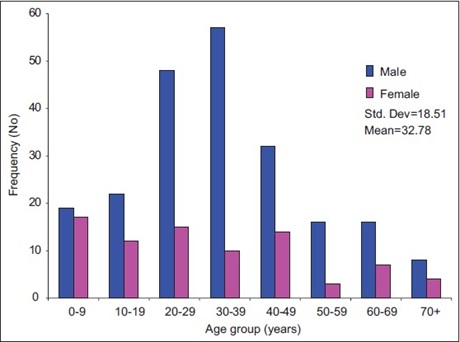
Results: The modal age group of the patients was the 30 to 39 year age group while the mean age was 32.78 years ± 18.51 standard deviation (SD) with a male: female ratio of 8:3. Abnormal CT scans were seen in 244 (81.4%) of the 300 patients studied. Of the 244 abnormal cases, 79 (32.4%) patients had midfacial fractures. The midfacial fractures were grouped
according to the proposed classification. Most of the fractures involved the sinonasal complex (SNC; 47.3%), while the remainder was almost equally distributed in the zygomatico-maxillary complex (ZGMC; 24.4%) and orbital complex (OC; 28.3%). Subgroups were assigned depending on the associated CT findings including soft tissue swelling, cranial fractures, and intracranial abnormalities.
Conclusion: Road traffic accidents (RTA) continue to be a major cause of head injury and midfacial fractures followed by falls and assault. We have described the CT findings in midfacial fractures following head injury in the study area and suggest a classification system for categorizing these fractures and associated findings.
Downloads
Article Details
Section

This work is licensed under a Creative Commons Attribution-NonCommercial 4.0 International License.
This is an open access journal, and articles are distributed under the terms of the Creative Commons Attribution-NonCommercial-ShareAlike 4.0 License, which allows others to remix, tweak, and build upon the work non-commercially, as long as appropriate credit is given and the new creations are licensed under the identical terms.
How to Cite
References
1. Iida S, Kogo M, Sugiura T, Mima T, Matsuya T. Retrospective analysis of 1502 patients with facial fractures. Int J Oral Maxillofac
Surg 2001;30:286‑90.
2. Abiose BO. The incidence and management of middle third facial fractures at the University Teaching Hospital, Ibadan. East Afr
Med J 1991;68:164‑73.
3. Fasola AO, Obiechina AE, Arotiba JT. Zygomatic complex fractures at the University College Hospital, Ibadan, Nigeria. East Afr Med
J 2002;79:137‑9.
4. Leech TR, Martin BC, Trabue JC. An analysis of the aetiology, treatment and complications of fractures of the malar compound and zygomatic arch. Am J Surg 1956;92:920‑4.
5. Ogunseyinde AO, Obajimi M, Ogundare SM. Radiological evaluation of head trauma by computer tomography in Ibadan, Nigeria. West Afr J Med 1999;18:33‑8.
6. Obajimi MO, Jumah KB, Brakohiapa WO, Iddirisu M. Head injury in ghanaians, evaluation by computed tomography. Ghana Med
J 2001;35:69‑74.
7. Agunloye AM, Adeyinka AO, Obajimi MO, Malomo A, Shokunbi MT. Computerized tomography of intracranial subdural haematoma in Ibadan. Afr J Med Med Sci 2003;32:235‑8.
8. Obajimi MO, Jumah KB, Brakohiapa WO, Iddirisu M. Computed tomography features of head injury in Ghanaian children. Nig J
Surg Res 2002;4:84‑8.
9. Akang EE, Kuti MA, Osunkoya AO, Komolafe EO, Malomo AO, Shokunbi MT, et al. Pattern of fatal head injuries in Ibadan: A 10 year
review. Med Sci Law 2002;42:160‑6.
10. Ogunlewe MO, James O, Ladeinde AL, Adeyemo WL. Pattern of paediatric maxillofacial fractures in Lagos, Nigeria. Int J Paediatr
Dent 2006;16:358‑62.
11. Obiekwe O, Owotade F, Osaiyuwa O. Aetiology and pattern of zygomatic complex fractures: A retrospective study. J Natl Med
Assoc 2005;97:992‑6.
12. Hussain K, Wijetunge DB, Grubnic S, Jackson IT. A comprehensive analysis of craniofacial trauma. J Trauma 1994;36:34‑47.
13. van As AB, van Loghem AJ, Biermans BF, Douglas TS, Wieselthaler N, Naidoo S. Causes and distribution of facial fractures in a group of South African children and the value of computed tomography in their assessment. Int J Oral Maxillofac Surg 2006;35:903‑6.
14. Odebode TO, Abubakar AM. Childhood head injury: Causes, outcome and outcome predictors. A Nigerian perspective. Peadiatr Surg Int 2004;20:348‑52.
15. Bankole OO, Fasola AO, Denloye OO. Oro‑facial soft tissue injuries in Nigerian children: A five‑year review. Afr J Med Med Sci 2004; 33:93‑7.
16. Abantanga FA, Mock CN. Childhood injuries in an urban area of Ghana a hospital‑based study of 677 cases. Pediatr Surg Int
1998; 13:515‑8.
17. Iida S, Matsuya T. Paediatric maxillofacial fractures: Their aetiological characters and fracture patterns. J Craniomaxillofac Surg 2002;30:237‑41.
18. Malara P, Malara B, Drugacz J. Characteristics of maxillofacial injuries resulting from road traffic accidents‑a 5 year review of
the case records from Department of Maxillofacial Surgery in Katowice, Poland. Head Face Med 2006;2:27.
19. Haug RH, Adams JM, Conforti PJ, Likavec MJ. Cranial fractures associated with facial fractures: A review of mechanism, type and
severity of injury. J Oral Maxillofac Surg 1994;52:729‑33.
20. Novelline RA, Rhea JT, Rao PM, Stuk JL. Helical CT in emergency radiology. Radiology 1999;213:321‑39.
21. Adeyemo WL, Ladeinde AL, Ogunlewe MO, James O. Trends and characteristics of oral and maxillofacial injuries in Nigeria: A review of literature. Head Face Med 2005;1:7.
22. Fasola AO, Nyako EA, Obiechina AE, Arotiba JT. Trends in the characteristics of maxillofacial fractures in Nigeria. J Oral Maxillofac Surg 2003;61:1140‑3.
23. Reuben A D, Watt ‑ Smith SR, Dibson D, Golding SJ. A comparative study of evaluation of radiographs, CT and reformatted CT in facial trauma: What is the role of 3D? Br J Radiol 2005;78:198‑201.
24. Rowe LD, Miller E, Brandt‑Zawadzki M. Computed tomography in maxillofacial trauma. Laryngoscope 1981;91:745‑57.
25. Hu H, He HD, Foley WD, Fox SH. Four multidetector‑row helical CT: Image quality and volume coverage speed. Radiology 2000; 215:55‑62.
26. Gentry LR, Manor WF, Turski PA, Strother CM. High‑resolution CT analysis of facial struts in trauma: 2. Osseous and soft tissue
complications. AJR Am J Roentgenol 1983;140:533‑41.
27. Buitrago‑Tellez CH, Schilli W, Bohnert M, Alt K, Kimmig M. A comprehensive classification of craniofacial fractures: Post mortem and clinical studies with two‑and three‑dimensional computed tomography. Injury 2002;33:651‑68.
28. Donat TL, Endress C, Mathog RH. Facial fracture classification according to skeletal support mechanisms. Arch Otolaryngol Head
Neck Surg 1998;124:1306‑14.
29. Avery LL, Susarla SM, Novelline RA. Multidetector and three‑dimensional CT evaluation of the patient with maxillofacial
injury. Radiol Clin North Am 2011;49:183‑203.
30. Obajimi MO, Shokunbi MT, Malomo AA, Agunloye AM. Computed Tomography (CT) in civilian gunshot head injuries in Ibadan. West Afr J Med 2004;23:58‑61.
31. Shintaku WH, Venturin JS, Azevedo B, Noujeim M. Applications of cone‑beam computed tomography in fractures of the maxillofacial complex. Dent Traumatol 2009;25:358‑66.
32. Le Fort R. Experimental study of fractures of the upper jaw. Rev Chir 1901;23:479‑507.
33. Manson PN, Hoopes JE, Su CT. Structural pillars of the facial skeleton: An approach to the management of Le Fort fractures.
Plast Reconstr Surg 1980;66:54‑62.
34. Lee RH, Gamble WB, Robertson B, Manson PN. The MCFONTZL classification system for soft tissue injuries to the face. Plast
Reconstr Surg 1999;103:1150‑7.
35. Jackson IT. Classification and treatment of orbitozygomatic and orbitoethmoid fractures. The place of bone grafting and plate
fixation. Clin Plast Surg 1989;16:77‑91.
36. Cooter RD, David DJ. Computer based coding of fractures in the craniofacial region. Br J Plast Surg 1989;42:17‑26.
37. Adebayo ET, Ajike OS, Adekeye EO. Analysis of the pattern of maxillofacial fractures in Kaduna, Nigeria. Br J Oral Maxillofac Surg 2003;41:396‑400.
38. Olasoji HO, Tahir A, Arotiba GT. Changing picture of facial fractures in northern Nigeria. Br J Oral Maxillofac Surg 2002;40:140‑3.
39. Ellis E 3 rd, el‑Attar A, Moos KF. An analysis of 2,067 cases of zygomatico‑orbital fracture. J Oral Maxillofac Surg 1985;43:417‑28.
40. Turvey TA. Midface fractures: A retrospective analysis of 593 cases. J Oral Surg 1977;35:887‑91.
41. Brook IM, Wood N. Aetiology and incidence of facial fractures in adults. Int J Oral Surg 1983;12:293‑8.
42. Busuito MJ, Smith DJ Jr, Robson MC. Mandibular fractures in an urban trauma centre. J Trauma 1986;26:826‑9.
43. Emshoff R, Shoning H, Rothler G, Waldhaet E. Trend in the incidence and cause of sport related mandibular fractures: A retrospective analysis. J Oral Maxillofac Surg 1997;55:585‑92.
44. Scherer M, Sulliven WG, Smith DJ Jr, Phillips LG, Robson MC. An analysis of 1,423 facial fractures in 788 patients at an urban trauma centre. J Trauma 1989;29:388‑90.
45. Starkhammer H, Olofsson J. Facial fractures: A review of 922 cases with special reference to incidence and aetiology. Clin Otolaryngol Allied Sci 1982;7:405‑9.
46. Kontio R, Suuronen R, Ponkkonen H, Lidqvist C, Laine P. Have the causes of maxillofacial fractures changed over the last 16 years
in Finland? An epidemiological study of 725 fractures. Dent Traumatol 2005;21:14‑9.
47. van Beek GJ, Merkx CA. Changes in the pattern of fractures of the maxillofacial skeleton. Int J Oral Maxillofac Surg 1999;28:424‑8.
48. Gassner R, Tuli T, Hachl O, Moreira R, Ulmer H. Craniomaxillofacial trauma in children: A review of 3,385 cases with 6,060 injuries in 10 years. J Oral Maxillofac Surg 2004;62:399‑407.
49. Haug RH, Prather J, Indresano AT. An epidemiologic survey of facial fractures and concomitant injuries. J Oral Maxillofac Surg
1990;48:926‑32.
50. Guven O. Fractures of the maxillofacial region in children. J Craniomaxillofac Surg 1992;20:244‑7.
51. Kaban LB. Diagnosis and treatment fractures of the facial bones in children 1943‑1993. J Oral Maxillofac Surg 1993;51:722‑9.
52. Tanaka N, Uchide N, Suzuki K, Tashiro T, Tomitsuka K, Kimijima Y, et al. Maxillofacial fractures in children. J Craniomaxillofac Surg
1993;21:289‑93.
53. Hopper RA, Salemy S, Sze RW. Diagnosis of Midface fractures with CT: What the surgeon needs to know. Radiographics 2006;26:783‑93.
54. Grant JH 3 rd, Patrinely JR, Weiss AH, Kierney PC, Gruss JS. Trapdoor fracture of the orbit in a paediatric population. Plast Reconstr Surg 2002;109:482‑9.
55. Linnau KF, Hallam DK, Lomoschitz FM, Mann FA. Orbital apex injury: Trauma at the junction between the face and the cranium.
Eur J Radiol 2003;48:5‑16.
56. Wiesenbaugh JM Jr. Diagnostic evaluation of zygomatic complex fractures. J Oral Surg 1970;28:204‑8.
57. Orakwe JC. Civilian gunshot wounds in a Nigerian general Hospital. Orient J Med 1992;4:24‑7.
58. Onuba O. Management of civilian gunshot wounds in a Nigerian general hospital. Arch Emerg Med 1987;4:73‑6.
59. Yinusa W, Ogirima MO. Extremity gunshot injuries in civilian practice: The National Orthopaedic Hospital Igbobi experience.
West Afr J Med 2000;19:312‑6.
60. Udosen AM, Etiuma AU, Ugare GA, Bassey OO. Gunshot injuries in Calabar, Nigeria: An indication of societal violence and police
brutality. Afr Health Sci 2006;6:170‑2.
61. Alcala‑Galiano A, Arribas‑Garcia IJ, Martin‑Perez MA, Romance A, Montalvo‑Moreno JJ, Juncos JM. Pediatric facial fractures: Children are not just small adults. Radiographics 2008;28:441‑61.
62. Kim JJ, Huoh K. Maxillofacial (midface) fractures. Neuroimaging Clin N Am 2010;20:581‑96.
63. Hong HS, Cha JG, Paik SH, Park SJ, Park JS, Kim DH, et al. High‑resolution sonography for nasal fractures in children. AJR Am J Roentgenol 2007;188:W86‑92.
64. Gruss JS, Mackinnon SE. Complex maxillary fractures: Role of buttress reconstruction and immediate bone grafts. Plast Reconstr
Surg 1986;78:9‑22.
65. Leipzinger LS, Manson PN. Nasoethmoid orbital fractures. Current concepts and management principles. Clin Plast Surg 1992; 19:167‑93.
66. Fujii N, Yamashiro M. Classification of malar complex fractures using computed tomography. J Oral Maxillofac Surg 1983; 41:562‑7.
67. Gomes PP, Pasieri LA, Barbosa JR. A 5‑year retrospective study of zygomatic‑orbital complex and zygomatic arch fractures in Sao
Paolo State, Brazil. J Oral Maxillofac Surg 2006;64:63‑7.
68. Strong BE, Pahlavan N, Saito D. Frontal sinus fractures: A 28 year retrospective review. Otolaryngol Head Neck Surg 2006; 135:774‑9.
69. Kwon J, Barrera JE, Jung TY, Most SP. Measurements of orbital volume change using computed tomography in isolated orbital
blowout fractures. Arch Facial Plast Surg 2009;11:395‑8.
70. Ong TK, Dudley M. Craniofacial trauma presenting in adult accident and emergency department with an emphasis on soft
tissue injuries. Injury 1999;30:357‑63.
71. Catapano J, Fialkov JA, Binhammer PA, McMillan C, AntonyshynOM. A new system for severity scoring of facial fractures: Development and validation. J Craniofac Surg 2010;21:1098‑103.
72. Country profiles for population and reproductive health: Policy development and indicators 2003. p. 70 UNFPA publication 2003.
Available from: http://www.unfpa.org/profile [Last accessed on May 2011].