
Distensibility coefficient of the common carotid artery in acute cerebral infarct by M‑mode ultrasound: A cross‑sectional study
Article Sidebar
Views | PDF/EPUB Downloads:
306
/ 64
/ 39
Main Article Content
Abstract
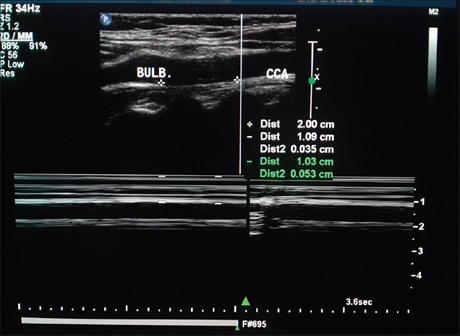
Introduction: Distensibility coefficient (DC) is abnormal in most cases of acute cerebral infarct patients. Intima-media thickness (IMT) is measured by B (brightness)-mode and distensibility by M (motion)-mode ultrasound. DC is not routinely measured in clinical practice even though it is the earliest functional change to occur in common carotid arteries. IMT represents structural change and DC represents functional changes that occur in common carotid.
Aim: DC is a valid independent indicator for risk assessment of acute cerebral infarcts. The present study is aimed at knowing the association of abnormal DC with acute cerebral infarct patients.
Materials and Methods: Cross sectional study was undertaken over a period of 9 months with 210 cases of acute cerebral infarct. Distensibility of common carotid artery was measured by M-mode ultrasound. Cramer’s V value ranged from 0.0 to 1.0 and P < 0.05 was considered statistically significant.
Results: DC was reduced in 62.8% of the total 210 cases of acute cerebral infarct. Maximum cases (38%) were in the age groups of 61–70 years. Cramer’s V value ranged from <15 to <24 × 10−3 kPa (P < 0.001). There was a good association between reduced DC and acute cerebral infarct in the present study.
Conclusion: DC is a valid independent risk factor for acute cerebral infarct. DC represents functional vessel wall property and decreases with age. M-mode-derived measurements for DC are valid, and abnormal DC value is associated well with acute cerebral infarct.
Downloads
Article Details
Section

This work is licensed under a Creative Commons Attribution-NonCommercial-ShareAlike 4.0 International License.
This is an open access journal, and articles are distributed under the terms of the Creative Commons Attribution-NonCommercial-ShareAlike 4.0 License, which allows others to remix, tweak, and build upon the work non-commercially, as long as appropriate credit is given and the new creations are licensed under the identical terms.
How to Cite
References
1. Rothwell PM. Carotid artery disease and the risk of ischaemic stroke and coronary vascular events. Cerebrovasc Dis 2000;10 Suppl 5:21‑33.
2. Oliver JJ, Webb DJ. Noninvasive assessment of arterial stiffness and risk of atherosclerotic events. Arterioscler Thromb Vasc Biol 2003; 23:554‑66.
3. Giannattasio C, Mancia G. Arterial distensibility in humans. Modulating mechanisms, alterations in diseases and effects of treatment.
J Hypertens 2002;20:1889‑99.
4. Gamble G, Zorn J, Sanders G, MacMahon S, Sharpe N. Estimation of arterial stiffness, compliance, and distensibility from M‑mode ultrasound measurements of the common carotid artery. Stroke 1994;25:11‑6.
5. van Popele NM, Grobbee DE, Bots ML, Asmar R, Topouchian J, Reneman RS, et al. Association between arterial stiffness and atherosclerosis: The Rotterdam study. Stroke 2001;32:454‑60.
6. Christensen T, Neubauer B. Increased arterial wall stiffness and thickness in medium‑sized arteries in patients with insulin‑dependent diabetes mellitus. Acta Radiol 1988;29:299‑302.
7. Hoeks AP, Brands PJ, Smeets FA, Reneman RS. Assessment of the distensibility of superficial arteries. Ultrasound Med Biol 1990;16:121‑8.
8. Selzer RH, Mack WJ, Lee PL, Kwong‑Fu H, Hodis HN. Improved common carotid elasticity and intima‑media thickness measurements from computer analysis of sequential ultrasound frames. Atherosclerosis 2001;154:185‑93.
9. Carallo C, Irace C, Pujia A, De Franceschi MS, Crescenzo A, Motti C, et al. Evaluation of common carotid hemodynamic forces. Relations with wall thickening. Hypertension 1999;34:217‑21.
10. Zieman SJ, Melenovsky V, Kass DA. Mechanisms, pathophysiology, and therapy of arterial stiffness. Arterioscler Thromb Vasc Biol 2005; 25:932‑43.
11. Safar ME, Girerd X, Laurent S. Structural changes of large conduit arteries in hypertension. J Hypertens 1996;14:545‑55.
12. Fazio MJ, Mattei MG, Passage E, Chu ML, Black D, Solomon E, et al. Human elastin gene: New evidence for localization to the long arm of chromosome 7. Am J Hum Genet 1991;48:696‑703.
13. Reneman RS, Hoeks AP, Westerhoff N. Non‑invasive assessment of artery wall properties in humans: methods and interpretation. J Vasc Invest 1996;2:53‑64.
14. Denarié N, Gariepy J, Chironi G, Massonneau M, Laskri F, Salomon J, et al. Distribution of ultrasonographically‑assessed dimensions of common carotid arteries in healthy adults of both sexes. Atherosclerosis 2000;148:297‑302.
15. Bots ML, Hoes AW, Koudstaal PJ, Hofman A, Grobbee DE. Common carotid intima‑media thickness and risk of stroke and myocardial
infarction: The Rotterdam study. Circulation 1997;96:1432‑7.
16. Kawasaki T, Sasayama S, Yagi S, Asakawa T, Hirai T. Non‑invasive assessment of the age related changes in stiffness of major branches
of the human arteries. Cardiovasc Res 1987;21:678‑87.
17. Reneman RS, Meinders JM, Hoeks AP. Non‑invasive ultrasound in arterial wall dynamics in humans: What have we learned and what
remains to be solved. Eur Heart J 2005;26:960‑6.
18. Wada T, Kodaira K, Fujishiro K, Maie K, Tsukiyama E, Fukumoto T, et al. Correlation of ultrasound‑measured common carotid artery stiffness with pathological findings. Arterioscler Thromb 1994;14:479‑82.
19. Tsivgoulis G, Vemmos K, Papamichael C, Spengos K, Daffertshofer M, Cimboneriu A, et al. Common carotid arterial stiffness and the risk of
ischaemic stroke. Eur J Neurol 2006;13:475‑81.
20. Godia EC, Madhok R, Pittman J, Trocio S, Ramas R, Cabral D, et al. Carotid artery distensibility: A reliability study. J Ultrasound Med 2007; 26:1157‑65.
21. Smilde TJ, Wollersheim H, Van Langen H, Stalenhoef AF. Reproducibility of ultrasonographic measurements of different carotid and femoral artery segments in healthy subjects and in patients with increased intima‑media thickness. Clin Sci (Lond) 1997;93:317‑24.
22. Arnett DK, Chambless LE, Kim H, Evans GW, Riley W. Variability in ultrasonic measurements of arterial stiffness in the atherosclerosis risk in communities study. Ultrasound Med Biol 1999;25:175‑80.
23. Pannier BM, AvolioAP, HoeksA, Mancia G, Takazawa K. Methods and devices for measuring arterial compliance in humans. Am J Hypertens 2002;15:743‑53.
24. Zhang J, Fletcher JG, Vrtiska TJ, Manduca A, Thompson JL, Raghavan ML, et al. Large‑vessel distensibility measurement with
electrocardiographically gated multidetector CT: Phantom study and initial experience. Radiology 2007;245:258‑66.